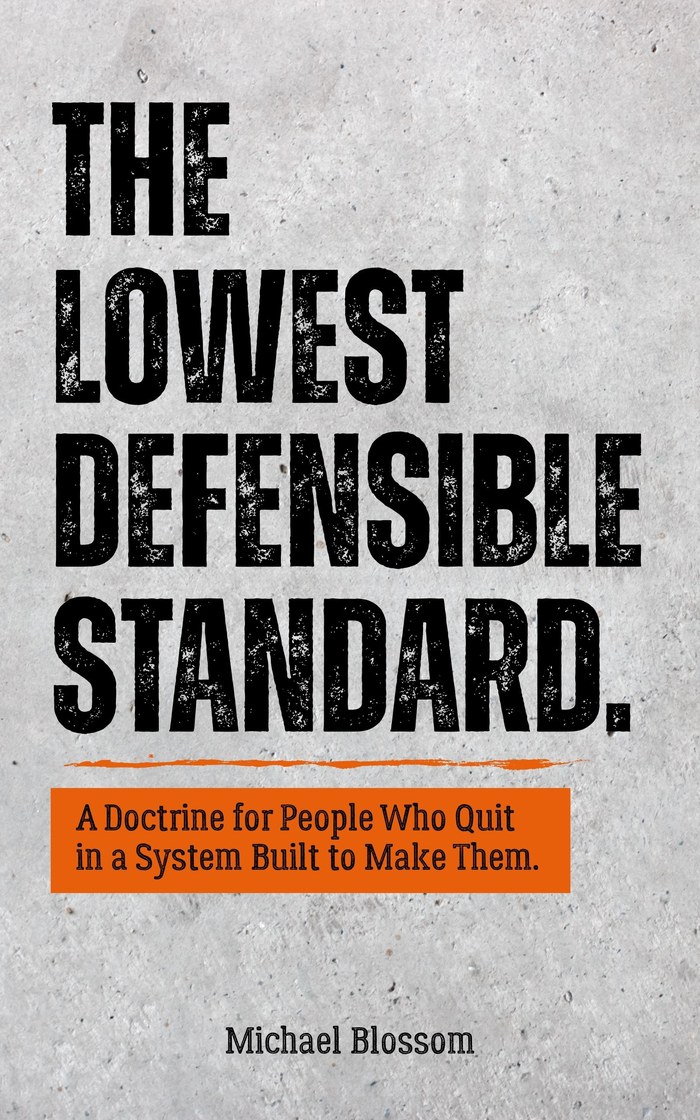
The Lowest
Defensible Standard
A Doctrine for People Who Quit in a System Built to Make Them
From the Back Cover
A brutal examination
of why capable people
keep starting over.
You are not distracted. You are not undisciplined. You are not lacking the right system, the right morning routine, or the right book.
You are inside an environment engineered to take your attention, your money, and your capacity to finish anything you start.
I started writing this book while sitting in a Kroger parking lot with five dollars in my bank account, after the hundred and twenty-sixth rejection email. I sat in the car and listed every single time I had ever quit something.
What I found is what this book is about. Not a system. Not five steps to anywhere. But a doctrine. A floor that serves as the lowest version of the work I would do on my worst day, modest enough that I could not fail to meet it, and therefore could not add it to my list of failures.
The environment is not neutral. It is engineered, not as blame, but as terrain.
This book will not fix you. But it might just help you stop trying to fix yourself. Which is a different thing... and a better one.
Michael Blossom
Read the Opening
The rejection email arrived while I was backing out of my driveway.
I’d applied for a hundred and twenty-six jobs. A hundred and twenty-six. This one felt different. The interview was remote. I’d done it the day before. When I left the house that morning I was still riding on the possibility of it. Still telling myself this was the one. Still believing that this time, something was finally about to shift.
Thirty minutes after I pulled out of the driveway, the email landed.
I drove to the Kroger parking lot and waited for a Door Dash order to come in. While I waited, I opened my bank account.
Five dollars.
I sat with that number for a minute. Then I put the phone down and looked out the windshield at nothing in particular.
That’s what I was, at 52 years old. A man in a thirteen-year-old car with five thousand dollars worth of repairs it was never going to get, waiting for an app to tell me someone needed their food delivered. Hoping the order wasn’t far away. Not just because of gas. Because the car had a limited number of miles left before the parts that needed fixing would simply stop working. I was rationing distance like it was something that could run out.
Which it could.
One of our two vehicles had already been repossessed. The other was paid off, which is the only reason we still had it. Disposable income had become a foreign concept. Not a tight month. Not a rough year. A years-long state of operating where every single dollar had somewhere it had to go before it arrived. Credit cards in collections. Credit score in the fives. We’d been borrowing money for rent for a full year. I’d told my wife we were going to be homeless so many times the words had stopped meaning anything. It had never happened. But it never stopped feeling like it was one bad week away.
She hadn’t had her hair or nails done since 2022. She was still using her mother’s old makeup. The things left behind after she passed. Replacing them wasn’t something we could justify. I don’t know if she ever said anything about that out loud. I know I thought about it more than I let on.
I used to golf twice a week. Minimum. That ended in December 2019 and hadn't come back.
We hadn't done anything for enjoyment since then. Not because life got busy. Because that's not what the money was for anymore.
The miracle, genuinely, is that neither of us turned to drugs or alcohol through any of it. Though if I’m being completely honest, and this book is going to be, we probably couldn’t have afforded them anyway. We were too broke to self-destruct properly. That’s not a virtue. That’s a budget constraint.
None of this started in the parking lot. The parking lot was the low point of a line that had been falling for a decade. We moved, and moved again. A pipe burst at home while we were in Florida for Amy’s mother. It flooded the first floor, the landlord would not fix it, and we lived in one room for months. Then Amy’s mother was gone. Then my brother. Five dollars in a parking lot is not where one bad week takes you. It is where a decade takes you, when the decade is heavy enough and you have been running it without a floor.
Sitting in that parking lot staring at five dollars, I did something I hadn't done in a long time.
I stopped.
And I started writing.
Not a plan. Not a strategy. I started writing down every single time I had quit something. Every business started and abandoned. Every commitment made and broken. I wasn't being kind about it. I let myself have it. You quit this. You walked away from that. You were close and you left anyway. Again and again and again.
I don't know how long I sat there. The app never made a sound.
And then something happened that I didn't expect.
I started seeing the pattern.
Not just that I quit things. I already knew that. Something more specific. The same sequence, running on a loop, across thirty years. Different industries, different stakes, different stories I told myself on the way out. But the same machine running the same program underneath all of it. Over and over, like I hadn’t written it but couldn’t stop executing it.
That was the beginning of this book.
Not a theory. Not a system built in a research lab. A man in a parking lot at the worst point in his life, finally sitting still long enough to look honestly at what he'd actually been doing.
What I found is what this book is about.
You know the feeling I’m describing. Maybe not the specific numbers or the specific parking lot. But the interior experience of it. That moment when the gap between where you are and where you thought you’d be gets too wide to explain away. The question that comes with it:
Why does this keep happening?
That question has an answer.
It's not the answer most books give you. It's not discipline or willpower or finding your why or wanting it badly enough. I tried all of those. For thirty years.
This is what I actually found.
That is the opening. The rest of the parking lot, the pattern underneath thirty years of it, and the floor that came out of that afternoon are in the book.
Buy on AmazonPaperback · Kindle
Read It
Buy on AmazonPaperback · Kindle
The Long Version
-
The Call I Didn’t Make
There is a kind of quitting nobody notices, including you. No scene, no rejection, no closed door. You have the idea, the person, and the permission. You mention it once, and then you just don’t. The story of the app I let someone else build.
-
The Scoreboard You Did Not Build
Three kinds of scoreboards run on your life. One runs on real data and can save you. One runs on interpretation and calls it a verdict. And one was built by somebody else so you would keep playing. Telling them apart changes everything.
-
Boredom Arrives on Schedule
Boredom is not proof you chose wrong. It is the moment the work stops feeding dopamine and starts asking for effort, right where most commitments quietly die. The signal everyone misreads, and the countermove that keeps you in.
-
When You Have Already Quit
Most books about finishing assume you are starting fresh. This one is for the person who has already quit, more than once. The difference between ending and quitting, and how to restart with structure instead of the motivation that already ran out.
-
Seen Before You're Ready
The quit nobody talks about does not happen when things fail. It happens when things are working and you are seen imperfectly. Why one comment can end four months of real work, and the countermove that keeps you in the game.
-
Desperation Is a Signal, Not a Strategy
Desperation always points at the thing you are not currently doing. Build X, and it swears Y was the answer. It feels like clarity. It is the opposite, and here is the reframe that puts you back in control.
-
The Scoreboard Never Pays Out
You hit the goal and the promised feeling never comes. Then the bar moves and you are behind again. That is not a discipline problem. It is a scoreboard built so you can never win on it, and the one move that gets you off the board.
-
The Next Idea Is How You Quit the Last One
A fresh idea feels like inspiration. Most of the time it is an exit that arrives the moment the work stops being new. Here is the trap that buries capable people, and the one thing that breaks it.
-
There Is No Such Thing as a Midlife Crisis
The car, the pivot, the marathon. Everyone calls it a midlife crisis. That phrase is not an explanation. It is a label that hides the mechanism, and the same loop runs at every age.
-
Working Harder and Getting Less: The Math Nobody Warns You About
If more effort keeps returning less, you're not burned out. You're on the wrong side of a curve. Here's the math, and the one thing that compounds.
-
Why Capable People Can't Finish What They Start
If you're great at starting and bad at finishing, it isn't a discipline problem. Here's the real pattern, and the one thing that breaks it.
About Michael
Start With One Page
Enter your email and I will send you the Floor Framework: one page, the smallest usable version of the whole idea, the part you can put to work tonight. No cost, no funnel, and a short essay when there is a new one.
Press & Conversations
Interviews and podcast appearances will be listed here as they happen.